Background & Context
The City of Berkeley identified that small and medium-sized businesses (SMBs), particularly women or minority-owned, are underrepresented in procurement and city contracting. The city wanted to understand why these SMBs do not participate in the process — is it due to lack of interest, lack of resources, or systemic issues around awareness and process complexity?
Our goal over one week was to develop a sustainable, inclusive, and accessible process and resource to expand opportunities to businesses receiving city contracts to drive equitable economic growth.
I worked with an interdisciplinary team, with students from public policy, data science, and business, to interview users, design a solution, and develop a pitch for the City of Berkeley.
Defining the Problem
The first step was defining who we were solving for, and understanding why the problem existed. Our primary user segment was small and medium women and minority business owners, specifically those who had not been awarded a city contract before. We knew that getting a clear problem statement was essential to ensure we were building the right solution.
Key questions we asked early on:
- Why aren't SMBs bidding on city contracts today?
- Is the barrier a lack of awareness, a lack of resources, or a confusing process?
- What part of the process is the most critical point where we could provide the most benefit?
Exploring the Solution Space
We began exploring the problem space and mapped out several directions the team could pursue:
Digital platform — create a digital resource to streamline applications and provide education for small businesses.
Policy changes — establish a dedicated task force, or increase city staffing dedicated to SMB procurement.
Community council — leverage local business leaders and organizations to spread awareness of opportunities.
With many different directions we could go in, and a limited time frame of only a few days, we needed user research to decide which direction had the most leverage.
User Research
We conducted research across two groups to ground our decisions in evidence rather than assumptions.
Stakeholder Interviews
We spoke directly with our city sponsors to understand existing processes, current pain points from the city's perspective, and available data on contract participation.
Business Owner Interviews
We conducted interviews with local business owners and business associations to ground our understanding in lived experience and narrow our scope to what actually mattered to users.
Key Insights
Synthesizing our qualitative research, four themes emerged:
The process is too long and confusing — the language and length of current forms creates significant friction.
SMBs have limited capacity — small business owners wear many hats and don't have time to navigate complex procurement processes.
Social media is underutilized — there's an opportunity to reach businesses where they already are.
Trust is key — businesses respond to outreach from trusted messengers and community partners, not just city communications.
The Solution
Based on these insights, we formulated our problem statement to focus on reducing friction in the onboarding process:
We believe that a more accessible on-ramp is needed — improving awareness, onboarding, and communication pathways before optimizing the application process itself. The MVP question was simple: how do we get people in the door first?
We decided the best solution addressed the problem from two angles:
1. Community Advisory Task Force
A representative council modeled after UC Berkeley's Procurement meetings, including voices from multiple community groups. Goals:
- Map the current bidder journey
- Facilitate listening sessions with underrepresented business communities
- Champion opportunities through trusted community networks
2. Technology Solution
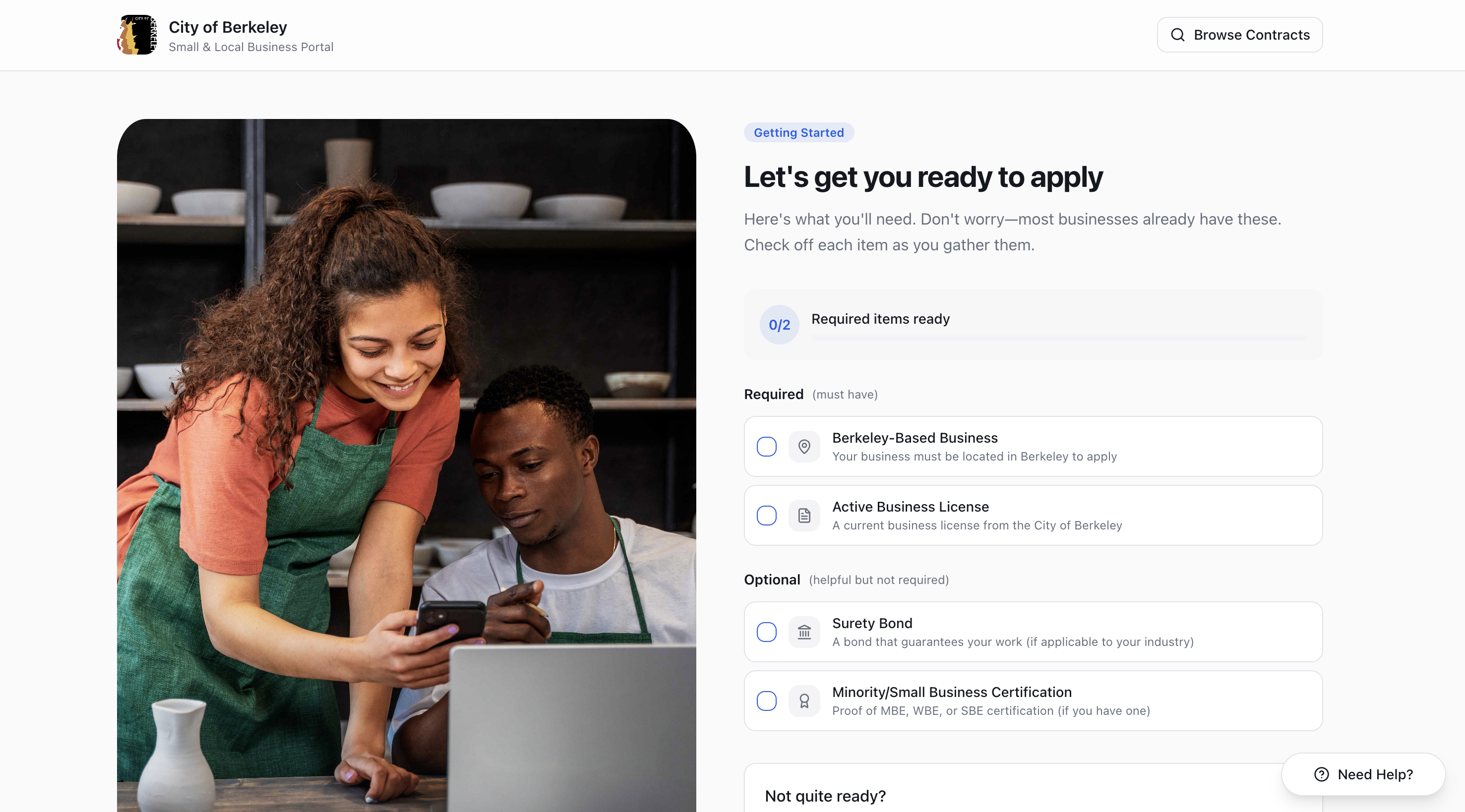
A guided onboarding experience and process checklist, paired with an improved opportunity dashboard with filtering capabilities. By splitting the solution into multiple releases, we could validate the MVP before adding additional features.
- Step-by-step onboarding flow for first-time bidders
- Filterable dashboard to browse open opportunities
- Streamlined and simplified application forms
- Social media outreach integration
- Live help and chat assistance
- Joint bid matchmaking system
Success Metrics
We defined four metrics to track the effectiveness of the solution across process, engagement, reach, and equity dimensions.
Retrospective
- A strong problem statement is everything. We can't solve every dimension of procurement inequity in one week. Narrowing scope early allowed our team to go deep on what actually mattered instead of spreading thin across too many directions.
- Wear multiple hats. Working in a multi-disciplinary team on a complex problem pushed me to think like a designer, a policymaker, and a business owner. Each lens revealed something the other missed.
- User insight drives better solutions. The pivot toward on-ramp accessibility (vs. jumping straight to form optimization) came directly from interviews. Without that research, we likely would have built the wrong solution.
- MVP thinking unlocks momentum. Rather than waiting for a perfect solution, we segmented the roadmap into release slices — prioritizing shipping meaningful improvements early and iterating from there.
If I had more time...
If I were to extend this project, I would conduct a competitive analysis to understand if other cities have processes to model from. I would also dig into current onboarding flows through user testing, and analyze drop-off points to determine where in the current process we could make the most gains.